com Computing Ltd Start a conversation
Case study

A credit union’s loan book, rebuilt rather than copied

Regulated finance, Isle of Man. Built at Future Proof Solutions, my earlier practice.

The old records arrived as fragments, so the book was not copied across. It was rebuilt from the arithmetic, and it reconciles to the treasurer’s own reports within a pound.

A community credit union in the Isle of Man: savings accounts and affordable loans, run by a small team who know their members by name. They wanted one system for all of it. They got loans, savings, treasury, audit and a member portal on one platform, and they run on it every day.

This was delivered through Future Proof Solutions, my earlier practice, and it is still operated from there. The full write-up is on that site ↗, with the screenshots and a short film. This page is the engineering account: what the data looked like, what was done about it, and how the go-live was rehearsed.

0
API endpoints
0+
Automated tests, from nothing in ninety days
0
Import pipelines, one per source
±£1
Reconciled against the treasurer’s reports
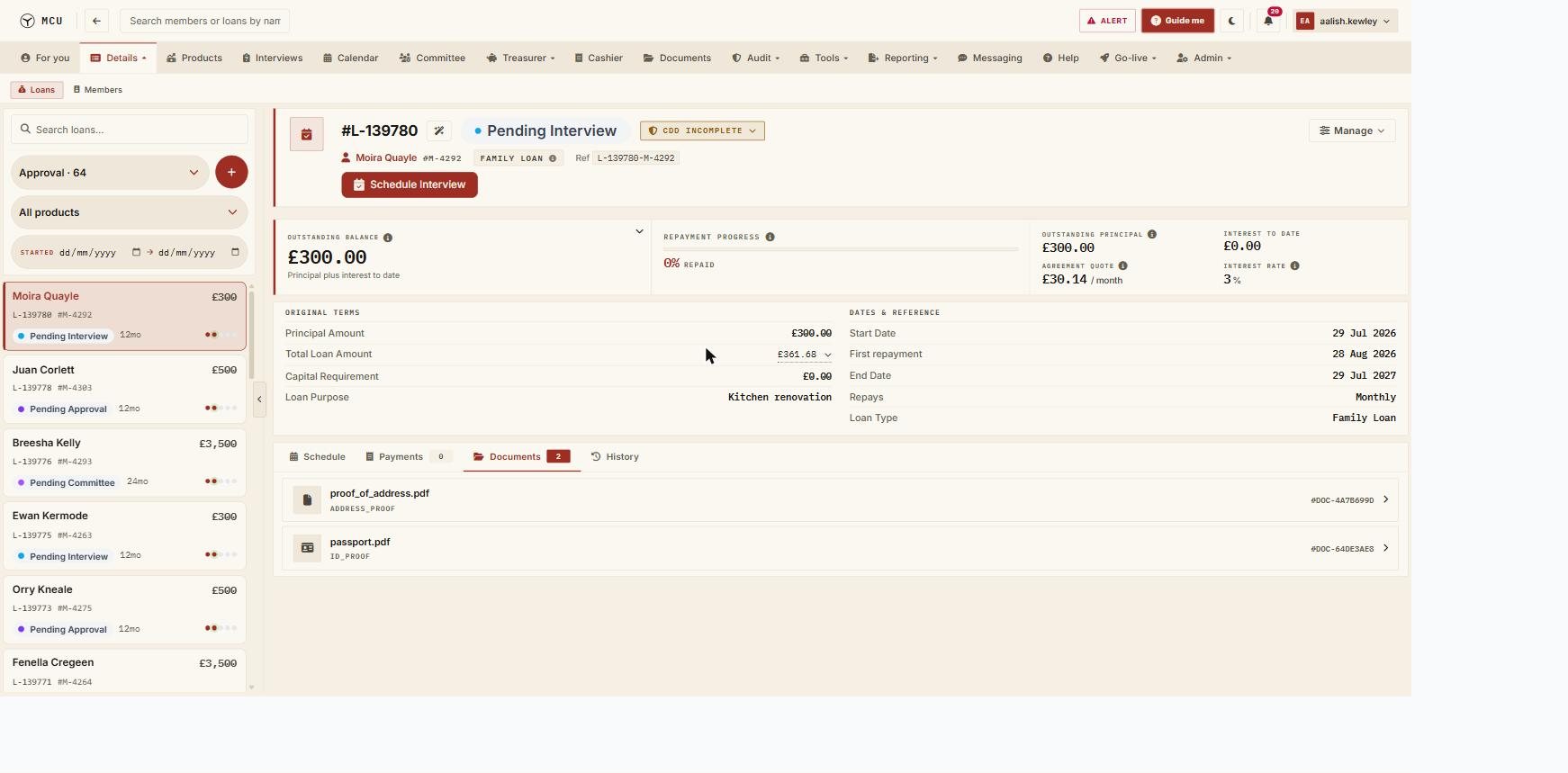
The staff app: a loan mid-lifecycle, with balance, repayment progress, terms and documents. Anonymised data.
The staff app, a loan mid-lifecycle. The names are fictional. The software is not.
§ 02

How it went, in order

The delivery looked nothing like the plan.

  1. 01

    The book arrived as fragments

    One export of 3,680 records with the names stripped, two membership spreadsheets, the weekly benefits file and the credit union's own paper till books. No dates of birth, no contact details, no documents and no transaction history for savings. Balances, and not much else.

    Out: nothing that could be copied across and trusted.

  2. 02

    Eight pipelines, each deriving what it loaded

    One import pipeline per source. Balances were computed from ledger history and never read from a field. Instalments were recovered from the payment schedules themselves. Duplicates were merged, and every row the arithmetic could not yet prove was parked where staff could see it, with a written note of what would resolve it.

    The book went live frozen. Repayments were open and outbound money was locked until each member re-verified their identity, then it opened one member at a time.

    Out: a book where every figure can be re-derived from payments, terms and the calendar.

  3. 03

    What the arithmetic found

    Recomputing every loan's life day by day turned up something no inspection would have. The old model only calculated interest when a payment arrived, so a loan nobody paid just froze. One had sat at the identical balance for thirteen and a half months.

    Where putting that right changed what members owed, it went in their favour. The family loan moved onto a daily basis that works out cheaper per year, applied retroactively.

    Out: reconciled to within one pound of the treasurer's own reports, with the interest income accounted for to the penny.

  4. 04

    Ninety days

    Most of the system as it runs today was designed and built in the last ninety days before launch, with the staff who use it. Four out of five commits in the whole history land in that window.

    AI agents wrote much of the code and I directed them, inside two controls. Every change passed an independent review, and the automated test suite grew from nothing to more than five thousand checks over the same ninety days.

    Out: more than a hundred screens across a staff app, a member portal, a desktop build and the public site.
  5. 05

    Three rehearsals, and a check that refused

    Going live on a real loan book was rehearsed three times, on exact copies of the live book. Production ran the day after the final rehearsal, so every payment-tied figure had to match to the penny and every calendar-tied figure had to move by exactly one day's interest. Both did.

    Part way through the run a safety check refused to write. Nobody overrode it. The cause was fixed, the untouched book was restored from a snapshot, and the run was repeated clean.

    Out: live in July 2026, and in daily use since.

§ 03

What it runs

One codebase behind the portal, the staff app and the office desktop build.

Members and the front desk

  • Member portal. Members apply for a loan, check balances and repayments, read their documents and keep their details current. Login is passwordless.
  • The whole loan lifecycle. Application, interview, affordability, credit checks, agreement signing, committee decision, payout, repayment, arrears. One history per loan.
  • Cashier. Cash deposits and loan repayments at the counter. Tills balance at close, and corrections need a second pair of eyes.

The back office

  • Committee decisioning. Weekly sessions with attendance and quorum, and every decision recorded with its reasoning.
  • Treasury. Bank statement imports with automatic payment matching, payout confirmation, an expense register and dividend modelling for the AGM.
  • Audit and compliance. Review queues for KYC, due diligence and payments, four-eyes corrections, and an inspection pack generated on demand.
§ 04

Boring technology, carefully arranged

Why this matters if your software touches money.

An Angular front end and a Spring Boot API on PostgreSQL, hosted on AWS. Nothing in it is new, and that is the point.

A dedicated authorisation server handles sign-in, trusted devices and passwordless login, and a gateway keeps tokens out of the browser entirely. Bank statements arrive over open banking, credit checks run through TransUnion, and loan statuses update live over WebSockets. A Playwright suite walks the money paths before anything reaches production.

Counted from the repositories at launch: 3,700 commits, 281 database migrations and a little over 870,000 lines of code.

If your own book lives in spreadsheets and exports and you are not sure the balances would survive being recomputed, that is the conversation to have. corey@comcomputing.im.